What is IGF1 LR3?
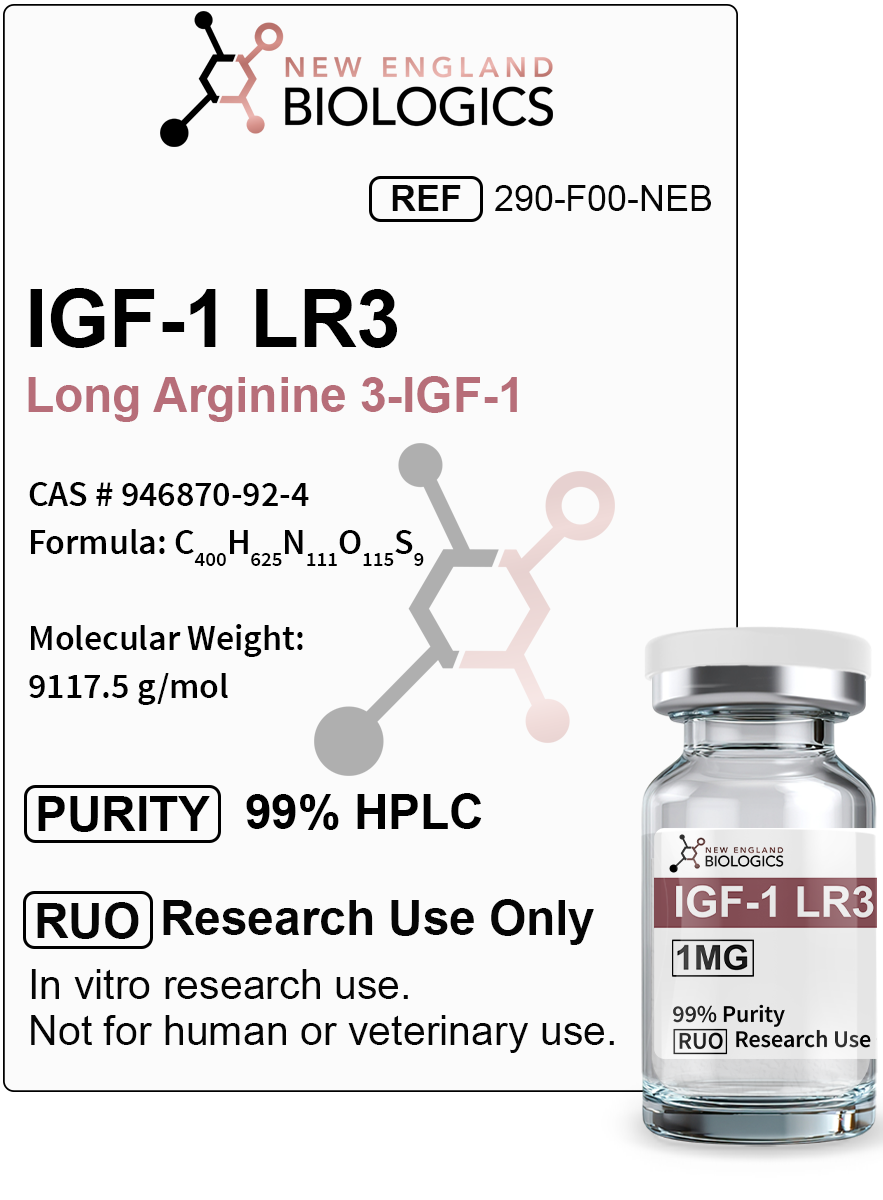
IGF-1 LR3 (Long Arginine 3-Insulin-like Growth Factor-1) is a synthetic analog of human insulin-like growth factor-1 (IGF-1), specifically engineered to exhibit enhanced metabolic stability and increased biological activity. The peptide consists of 83 amino acids with a molecular weight of approximately 9.1 kDa, distinguished from native IGF-1 (70 amino acids) by two critical structural modifications: substitution of arginine for glutamic acid at position 3 and addition of a 13-amino acid extension at the N-terminus.
These modifications fundamentally alter the peptide's pharmacological properties. Native IGF-1 exists predominantly bound to IGF-binding proteins (IGFBPs) in circulation, which sequester the growth factor and limit its bioavailability to target tissues. IGF-1 LR3's structural changes significantly reduce its binding affinity for IGFBPs by approximately 100-fold, allowing greater interaction with IGF-1 receptors on target cells. This reduced binding results in an extended half-life of 20-30 hours compared to native IGF-1's 12-15 hour half-life, and enhances biological potency approximately three times that of the endogenous hormone.
IGF-1 LR3 primarily exerts its effects through activation of the IGF-1 receptor (IGF-1R), a transmembrane tyrosine kinase receptor expressed in muscle, bone, connective tissue, and various other cell types. Upon binding to IGF-1R, the peptide initiates multiple intracellular signaling cascades, including the phosphoinositide 3-kinase (PI3K)/Akt/mTOR pathway, which regulates protein synthesis and cell growth, and the mitogen-activated protein kinase (MAPK) pathway, which controls cell proliferation and survival. Through these mechanisms, IGF-1 LR3 stimulates cellular anabolism, enhances glucose and amino acid uptake, increases protein synthesis, and inhibits protein degradation.
The peptide was originally developed for cell culture applications to accelerate cell proliferation in laboratory research. However, subsequent investigation revealed its potential therapeutic value in conditions characterized by protein catabolism, muscle wasting, impaired tissue repair, and metabolic dysfunction. Unlike native IGF-1, which requires frequent administration due to its short half-life and extensive IGFBP binding, IGF-1 LR3's enhanced stability and bioavailability make it a more practical candidate for investigating growth factor-mediated tissue regeneration and metabolic regulation.
Chemical Identity
The compound is characterized by its unique molecular structure and specific chemical properties that make it valuable for research applications.Purity & Quality
Our IGF1 LR3 is provided at research-grade purity, suitable for laboratory applications and experimental protocols. Each batch undergoes quality control testing to ensure consistency and reliability for your research needs. Important: This product is intended for research purposes only and is not for human or veterinary use. It is sold for laboratory and scientific investigation only.IGF1 LR3 Structure
Chemical Structure
2D Structure

3D Structure

Chemical Properties
| CAS Number | 946870-92-4 |
|---|---|
| Molecular Formula | C80H154N4O6S2 |
| Molecular Weight | 1332.2 g/mol |
| IUPAC Name |
2-[4-[2-[3-[bis(2-hydroxyoctadeca-9,12-dienyl)amino]propyldisulfanyl]ethyl]piperazin-1-yl]ethyl 5-[bis(2-hydroxytetradecyl)amino]pentanoate
|
| InChIKey | CRZOPHSORDIMRX-UHFFFAOYSA-N |
IGF1 LR3 Research
Research Applications
Muscle Growth and Protein Metabolism
IGF-1 LR3 demonstrates significant effects on skeletal muscle protein metabolism and muscle mass preservation. A pivotal 1999 study by Hill et al. investigated the effects of IGF-1 LR3 infusion on protein metabolism in beef heifers undergoing weight loss due to restricted feeding. Results showed that continuous intravenous infusion of IGF-1 LR3 tended to preserve both whole-body protein and skeletal muscle protein during the catabolic state. The peptide markedly reduced plasma concentrations of all measured amino acids and glucose, indicating enhanced cellular uptake. These findings suggest IGF-1 LR3 promotes nitrogen retention and reduces protein breakdown, even during periods of energy restriction.
The mechanisms underlying IGF-1 LR3's anabolic effects involve activation of the PI3K/Akt/mTOR signaling pathway, which stimulates ribosomal protein S6 and translation initiation factors downstream of mTORC1, thereby enhancing protein synthesis. Simultaneously, Akt activation suppresses the ubiquitin proteasome system through inhibition of FoxO-mediated transcription of E3 ubiquitin ligases (MAFbx/Atrogin-1, MuRF1), which are responsible for protein degradation. This dual mechanism—increased synthesis combined with decreased breakdown—results in net protein accretion in muscle tissue.
IGF-1 LR3 also promotes muscle cell proliferation and differentiation through activation of satellite cells, the resident stem cells of skeletal muscle. These cells normally exist in a quiescent state but become activated following muscle injury or mechanical stimulation, proliferating and fusing with existing muscle fibers to support hypertrophy and repair. IGF-1 LR3 directly stimulates satellite cell activation, proliferation, and fusion, processes essential for muscle regeneration and growth. The peptide enhances the conversion of multipotent stem cells into committed muscle lineage cells, accelerating muscle development and tissue repair.
Sources:
- Hill RA, Hunter RA, Lindsay DB, Owens PC. Action of long(R3)-insulin-like growth factor-1 on protein metabolism in beef heifers. Domestic Animal Endocrinology. 1999;16(4):219-229. https://pubmed.ncbi.nlm.nih.gov/10370861/
- Schiaffino S, Mammucari C. Regulation of skeletal muscle growth by the IGF1-Akt/PKB pathway: insights from genetic models. Skeletal Muscle. 2011;1:4. https://pmc.ncbi.nlm.nih.gov/articles/PMC4449334/
- Rommel C, Bodine SC, Clarke BA, et al. Mediation of IGF-1-induced skeletal myotube hypertrophy by PI(3)K/Akt/mTOR and PI(3)K/Akt/GSK3 pathways. Nature Cell Biology. 2001;3:1009-1013. https://pmc.ncbi.nlm.nih.gov/articles/PMC4449334/
Protection Against Muscle Damage and Dystrophy
IGF-1 LR3 exhibits protective effects against contraction-induced muscle injury, particularly relevant in muscular dystrophy pathophysiology. Gehrig et al. (2008) demonstrated that systemic administration of IGF-1 LR3 to dystrophic mdx mice (a model of Duchenne muscular dystrophy) significantly reduced susceptibility to contraction-mediated damage in extensor digitorum longus, soleus, and diaphragm muscles. Following a protocol of lengthening contractions, muscles from IGF-1 LR3-treated animals exhibited lower force deficits compared to controls, indicating enhanced resistance to mechanical injury.
Notably, this protective effect occurred through mechanisms independent of changes in muscle oxidative metabolism or fatigue resistance, distinguishing IGF-1 LR3's mechanism from native IGF-1. The protection appears to result from the peptide's ability to bypass inhibitory IGFBP interactions, allowing more effective activation of IGF-1 signaling pathways that enhance sarcolemmal stability and reduce membrane damage during eccentric contractions. Contraction-mediated injury represents a major pathological contributor to progressive muscle degeneration in muscular dystrophy, making therapies that attenuate this type of damage clinically relevant.
Additional studies in multiple dystrophic mouse models have confirmed IGF-1 analog benefits in improving muscle function and reducing pathological features. The peptide's muscle-protective properties extend beyond genetic muscle diseases, with potential applications in preventing exercise-induced muscle damage, accelerating recovery from injury, and maintaining muscle mass during periods of disuse or immobilization.
Sources:
- Gehrig SM, Ryall JG, Schertzer JD, Lynch GS. Insulin-like growth factor-I analogue protects muscles of dystrophic mdx mice from contraction-mediated damage. Experimental Physiology. 2008;93(11):1190-1198. https://pubmed.ncbi.nlm.nih.gov/18567600/
- Lynch GS. The therapeutic potential of IGF-I in skeletal muscle repair. Current Opinion in Pharmacology. 2013. https://pmc.ncbi.nlm.nih.gov/articles/PMC3732824/
- Gehrig SM, van der Poel C, Hoeflich A, et al. Therapeutic potential of PEGylated insulin-like growth factor I for skeletal muscle disease evaluated in two murine models of muscular dystrophy. Growth Hormone & IGF Research. 2012;22:69-75. https://www.sciencedirect.com/science/article/abs/pii/S1096637412000196
Tendon and Connective Tissue Repair
IGF-1 demonstrates potent effects on tendon healing and connective tissue regeneration through multiple mechanisms. Research reveals that IGF-1 facilitates tendon regenerative healing by modulating inflammatory responses, promoting tenocyte proliferation and migration, enhancing collagen production—particularly type I collagen which comprises the primary structural component of tendon tissue—and inducing appropriate cell differentiation during the repair process.
In vitro studies demonstrate that IGF-1 significantly increases DNA synthesis and collagen I production in tenocyte cultures. The growth factor stimulates tenocyte proliferation in a dose-dependent manner and maintains cell viability in serum-free conditions when combined with other growth factors. In vivo animal studies confirm these findings, showing that IGF-1 treatment accelerates functional recovery from Achilles tendon injury, improves tendon mechanical properties, and enhances collagen organization and composition in healing ligaments.
Systematic administration of IGF-1 has been shown to enhance healing in collagenous extracellular matrices. Studies using medial collateral ligament (MCL) injury models demonstrate that IGF-1 treatment improves mechanical properties and promotes more organized collagen architecture during healing. The peptide increases the cross-sectional area of regenerating tendon tissue and promotes a greater expansion of neotendon formation over time. Additionally, IGF-1 supports the differentiation of mesenchymal stem cells toward tenogenic lineages, a critical process for successful tendon regeneration.
The mechanisms underlying IGF-1's tendon repair effects involve activation of the IGF-1 receptor on tenocytes and tendon stem cells, leading to enhanced extracellular matrix synthesis, improved cellular migration to injury sites, and optimized remodeling of repair tissue. These effects make IGF-1 a promising therapeutic approach for tendon injuries, which typically heal slowly and often result in inferior mechanical properties compared to uninjured tissue.
Sources:
- Miescher I, Rieber J, Calcagni M, Buschmann J. In vitro and in vivo effects of IGF-1 delivery strategies on tendon healing: A review. International Journal of Molecular Sciences. 2023;24(3):2370. https://pmc.ncbi.nlm.nih.gov/articles/PMC9916536/
- Wang K, Chen Y, Wu J, et al. Insulin-like growth factor-1 (IGF-1) empowering tendon regenerative therapies. Frontiers in Bioengineering and Biotechnology. 2025. https://www.frontiersin.org/journals/bioengineering-and-biotechnology/articles/10.3389/fbioe.2025.1492811/full
- Provenzano PP, Alejandro-Osorio AL, Valhmu WB, et al. Systemic administration of IGF-I enhances healing in collagenous extracellular matrices: evaluation of loaded and unloaded ligaments. Journal of Orthopaedic Research. 2007. https://pmc.ncbi.nlm.nih.gov/articles/PMC1851714/
Glucose Metabolism and Insulin Sensitivity
IGF-1 plays a critical role in glucose homeostasis and insulin sensitivity through both direct and indirect mechanisms. The peptide shares approximately 48% amino acid sequence homology with insulin and binds to insulin receptors, though with lower affinity than insulin itself. More significantly, IGF-1 activates hybrid insulin/IGF-1 receptors and stimulates glucose transport in skeletal muscle and adipose tissue through mechanisms similar to insulin.
Studies demonstrate that IGF-1 enhances insulin sensitivity by promoting glucose uptake in peripheral tissues while suppressing hepatic glucose production. The peptide activates the PI3K/Akt signaling cascade, leading to translocation of GLUT4 glucose transporters to the cell membrane and increased cellular glucose uptake. Additionally, IGF-1 indirectly improves insulin sensitivity by suppressing growth hormone (GH) secretion through negative feedback mechanisms; elevated GH levels promote insulin resistance through direct antagonistic effects on insulin signaling, and IGF-1-mediated GH suppression alleviates this resistance.
Research in animal models reveals that central nervous system IGF-1 expression significantly improves glucose tolerance and enhances insulin sensitivity. Mice receiving IGF-1 treatment showed increased serum insulin levels, reduced blood glucose levels, improved glucose tolerance, and enhanced insulin sensitivity. These metabolic improvements occurred alongside increased phosphorylation of insulin receptor substrate and Akt, key signaling molecules in the insulin/IGF-1 pathway.
Clinical studies support IGF-1's role in metabolic regulation. Low circulating IGF-1 levels are associated with increased risk of insulin resistance, metabolic syndrome, and type 2 diabetes development. Conversely, IGF-1 administration to patients with insulin resistance has demonstrated improvements in glycemic control and enhanced insulin sensitivity. The peptide's glucose-lowering effects partially result from its ability to increase fatty acid oxidation in muscle tissue, reducing free fatty acid flux to the liver and improving insulin's suppression of hepatic glucose output.
Sources:
- Clemmons DR. Role of insulin-like growth factor I in maintaining normal glucose homeostasis. Hormone Research. 2004;62(Suppl 1):77-82. https://pubmed.ncbi.nlm.nih.gov/15761237/
- Qiu Z, Wei Y, Song Q, et al. Central IGF1 improves glucose tolerance and insulin sensitivity in mice. Nutrition & Diabetes. 2017. https://www.nature.com/articles/s41387-017-0002-0
- Aguirre GA, De Ita JR, de la Garza RG, Castilla-Cortazar I. Insulin-like growth factor-1 deficiency and metabolic syndrome. Journal of Translational Medicine. 2016;14:3. https://link.springer.com/article/10.1186/s12967-015-0762-z
- Clemmons DR. Metabolic actions of IGF-I in normal physiology and diabetes. Endocrinology and Metabolism Clinics. 2012. https://pmc.ncbi.nlm.nih.gov/articles/PMC3374394/
Cellular Proliferation and Tissue Development
IGF-1 LR3 functions as a potent stimulus for cellular proliferation across multiple tissue types through its activation of IGF-1 receptors and downstream signaling pathways. The peptide's primary mitogenic actions involve stimulation of the MAPK/ERK pathway, which promotes cell cycle progression, and the PI3K/Akt pathway, which enhances cell survival and prevents apoptosis. These coordinated effects accelerate cell division rates and support tissue development and regeneration.
Research demonstrates that IGF-1 LR3 exhibits superior cell proliferation activity compared to native IGF-1 when tested in cell culture systems. The peptide's reduced binding to IGFBPs allows greater bioavailability and more sustained receptor activation, making it particularly effective for accelerating cell growth in laboratory applications. Studies in mammalian cell culture reveal that supplementation with IGF-1 LR3 at concentrations significantly lower than standard insulin or native IGF-1 results in enhanced cell productivity and proliferation rates.
The peptide influences multiple cell types essential for tissue repair and regeneration. In skeletal muscle, IGF-1 LR3 activates satellite cells, promoting their proliferation and differentiation into mature muscle fibers—a process termed hyperplasia (increase in cell number) distinct from hypertrophy (increase in cell size). In connective tissues, the peptide stimulates fibroblast proliferation and extracellular matrix synthesis. In vascular tissues, IGF-1 supports endothelial cell growth and angiogenesis, contributing to improved tissue perfusion during healing.
Animal studies demonstrate that IGF-1 LR3 administration increases organ weight through enhanced cellular proliferation. Seven-day continuous infusion of IGF-1 LR3 in guinea pigs significantly increased the fractional weight of adrenals, gut, kidneys, and spleen compared to controls, indicating tissue growth effects. These proliferative actions occur through activation of anabolic signaling pathways that coordinate increased DNA synthesis, enhanced protein production, and accelerated cell division across target tissues.
Sources:
- Conlon MA, Tomas FM, Owens PC, et al. Long R3 insulin-like growth factor-I (IGF-I) infusion stimulates organ growth but reduces plasma IGF-I, IGF-II and IGF binding protein concentrations in the guinea pig. Journal of Endocrinology. 1995;146(2):247-253. https://pubmed.ncbi.nlm.nih.gov/7561636/
- Araujo MS, Guastali MD, Paulini F, et al. Molecular and cellular effects of insulin-like growth factor-1 and LongR3-IGF-1 on in vitro maturation of bovine oocytes: comparative study. Growth Hormone & IGF Research. 2020. https://pubmed.ncbi.nlm.nih.gov/37261455/
- Francis GL, Ross M, Ballard FJ, et al. Novel recombinant fusion protein analogues of insulin-like growth factor (IGF)-I indicate the relative importance of IGF-binding protein and receptor binding for enhanced biological potency. Journal of Molecular Endocrinology. 1992. https://pmc.ncbi.nlm.nih.gov/articles/PMC1137054/
Metabolic Regulation and Fat Metabolism
IGF-1 plays important roles in lipid metabolism and energy homeostasis through effects on both fat storage and utilization. The peptide promotes fatty acid oxidation in skeletal muscle, enhancing the utilization of lipids as an energy source while sparing glucose for other metabolic processes. This metabolic flexibility—the capacity to efficiently switch between carbohydrate and fat oxidation—represents a key component of healthy metabolism.
Research demonstrates that IGF-1 stimulates fatty acid uptake and β-oxidation in muscle tissue through multiple mechanisms. The peptide activates AMP-activated protein kinase (AMPK), a central regulator of cellular energy metabolism that promotes fatty acid oxidation while inhibiting lipid synthesis. Additionally, IGF-1 enhances expression and activity of enzymes involved in fatty acid metabolism, including carnitine palmitoyltransferase-1, the rate-limiting enzyme for fatty acid entry into mitochondria for oxidation.
The peptide's effects on fat metabolism also involve its insulin-like actions. IGF-1 stimulates glucose and amino acid transport into cells, particularly muscle tissue, promoting anabolic processes while reducing substrate availability for fat storage. This nutrient partitioning effect directs dietary nutrients toward muscle protein synthesis and away from adipose tissue storage. Animal studies demonstrate that IGF-1 treatment reduces circulating free fatty acid levels, potentially through increased muscle uptake and oxidation combined with reduced adipose tissue lipolysis.
IGF-1's metabolic effects extend to whole-body energy balance through its regulation of growth hormone secretion. Elevated GH levels promote lipolysis and increase circulating fatty acids, effects that can contribute to insulin resistance. IGF-1's suppression of GH secretion through negative feedback indirectly improves metabolic function by reducing GH-mediated lipolysis and its associated insulin-antagonistic effects. This complex interplay between IGF-1, GH, and insulin coordinates metabolic regulation across fed and fasted states.
Studies in metabolic syndrome and obesity models show that low IGF-1 levels correlate with dysregulated lipid metabolism, increased visceral adiposity, and impaired insulin sensitivity. Restoration of IGF-1 through administration or increased endogenous production has demonstrated improvements in lipid profiles, reduced adipose tissue accumulation, and enhanced metabolic health markers.
Sources:
- Aguirre GA, De Ita JR, de la Garza RG, Castilla-Cortazar I. Insulin-like growth factor-1 deficiency and metabolic syndrome. Journal of Translational Medicine. 2016;14:3. https://link.springer.com/article/10.1186/s12967-015-0762-z
- Clemmons DR. Metabolic actions of IGF-I in normal physiology and diabetes. Endocrinology and Metabolism Clinics. 2012. https://pmc.ncbi.nlm.nih.gov/articles/PMC3374394/
- Yakar S, Liu JL, Stannard B, et al. Normal growth and development in the absence of hepatic insulin-like growth factor I. Proceedings of the National Academy of Sciences. 1999. https://pmc.ncbi.nlm.nih.gov/articles/PMC4449334/